This page is very much a work in progress and needs tidying up…
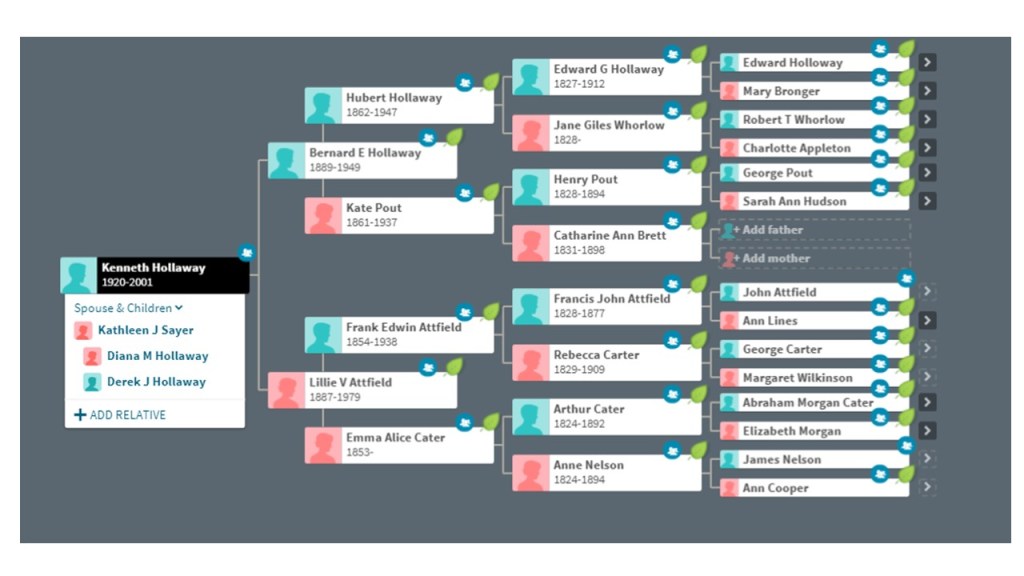
Descendents of Edward and Jane Hollaway
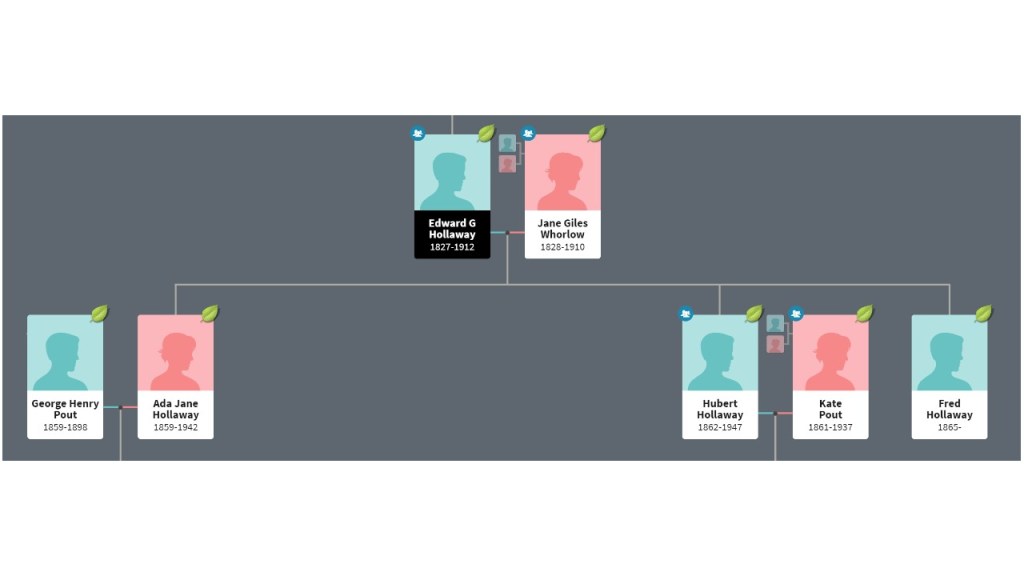
Edward and Jane had 3 children: Ada Jane, Hubert and Fred.
Ada Jane
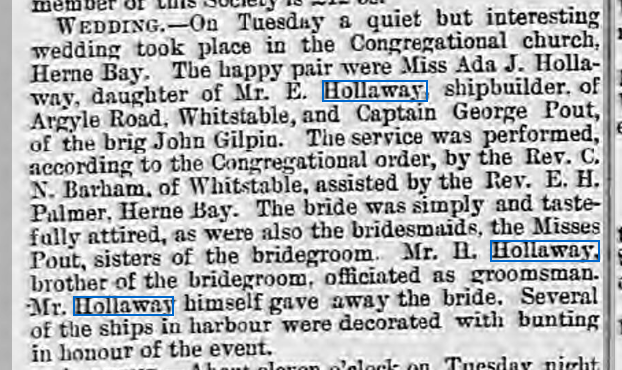
Ada Jane married Captain George Henry Pout in January 1883.
They had 7 children:
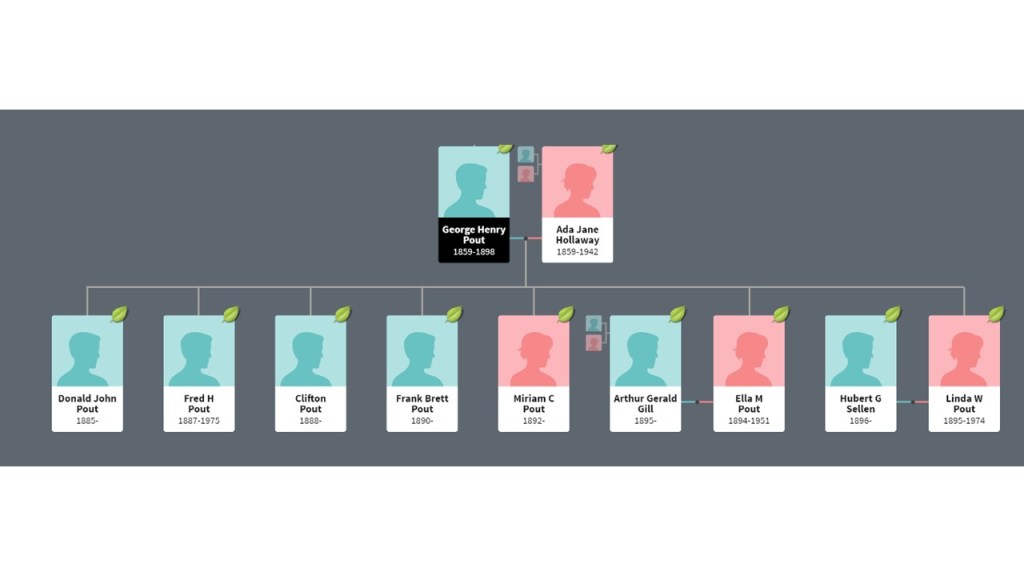
Ella Maud Pout
Born June 1893, Whitstable.
Married Arthur Gerald Gill, December 1920, Blean, Kent.
1923 – birth of son, Ivan G Gill. Ivan married Barbara M Gautrey in 1950.
Linda Whorlow Pout
Born 1895, Faversham, Kent.
Married Hubert G Sellen 1923.
Hubert
Hubert and Kate had one child, Bernard. Bernard had one child, Kenneth (my grandfather).
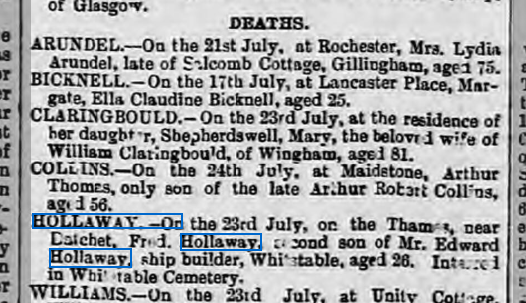
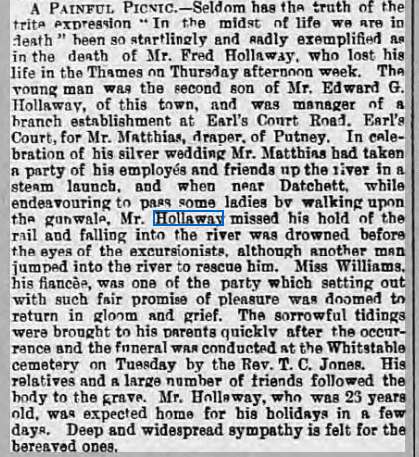
Fred
Born 1865, Whitstable.

At the age of 16 he was living in London and was a draper’s apprentice.

At 26 he was a draper’s manager

Fred died at the age of 26 in an accident in Datchet, near Slough.
Attfields
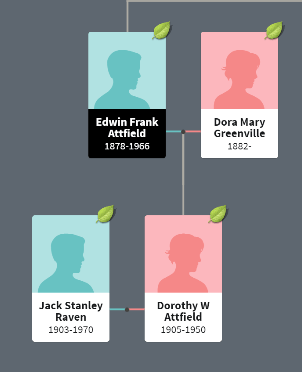
Edwin Frank Attfield married Dora, they had one child, Dorothy.
Dorothy married Jack Raven 1 September 1935.
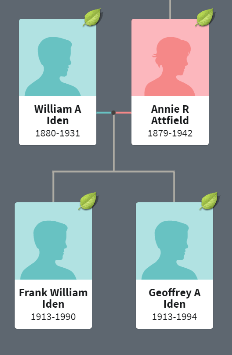
Annie Attfield married William Iden and they had two children, Frank and Geoffery.
William Attfield married Dorothy and they had three children, William, Frank and Ronald.

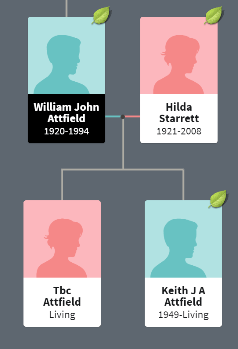
William married Hilda and they had two children, a daughter (name unknow) and Keith.
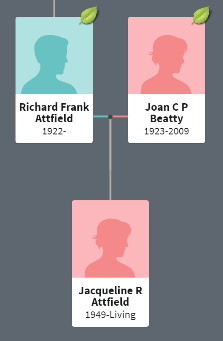
Richard married Joan and they had one child, Jacqueline
Ronald married Jean and they had four children, Janet, Amanda, Elizabeth and another daughter (name unknown).
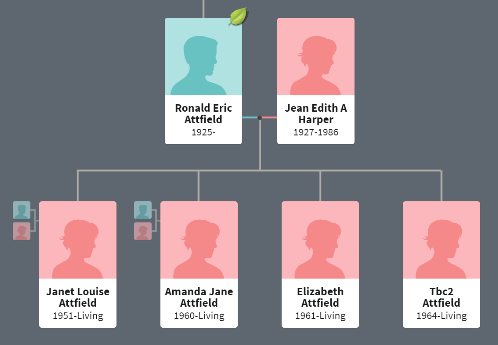
Janet married Peter Zerfahs in 1984.
Amanda married Brian Salt in 1981, they had one child, Philippa, who was born 26 July 1998.
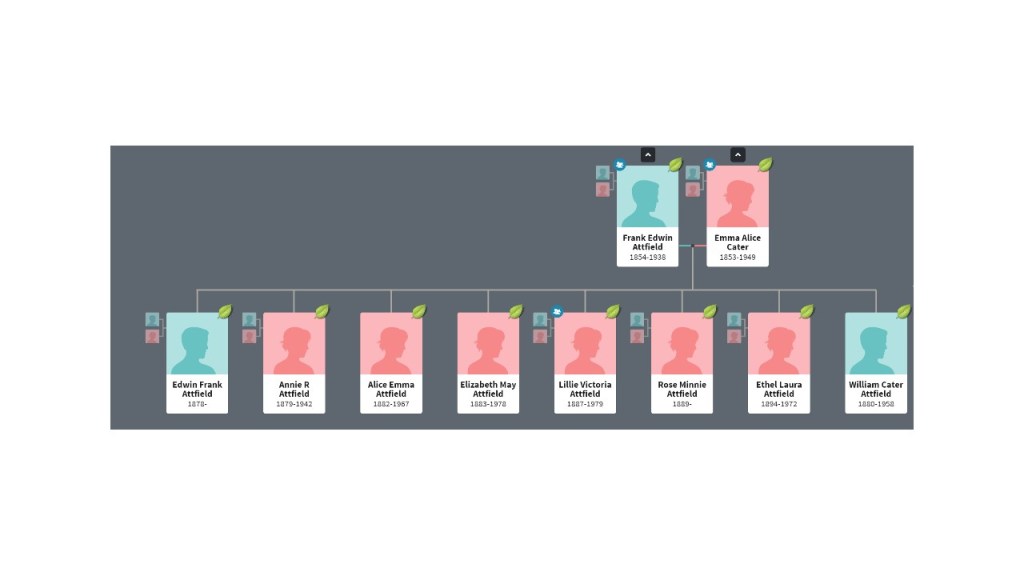
Alice Emma Attfield did not marry. She died 7 Mar 1967, her death was reported by her nephew, Ken Hollaway.
Elizabeth May Attfield did not marry. She died 7 Feb 1978.
Lillie Victoria Attfield married Ken Hollaway and they had two children, Diana and Derek.
Rose Minnie Attfield married Edwin James Ham in 1912 in New Zealand. They had one child, Frank Edwin Ham (1913-1987).
Frank married Margaret Willett.
Ethel Laura Attfield married Edgar Walter Self in 1917. They had one child, Joan Eileen Self, (1919-2006)
Joan married Douglas William Joseph Kallenborn (1914-1984) in 1943.
Whorlows
Robert Tritton Whorlow and Charlotte Whorlow had 9 children:
Elizabeth Whorlow (born 1825) married Richard Baker in 1852 in Blean. Richard was a mariner and later an oyster merchant.
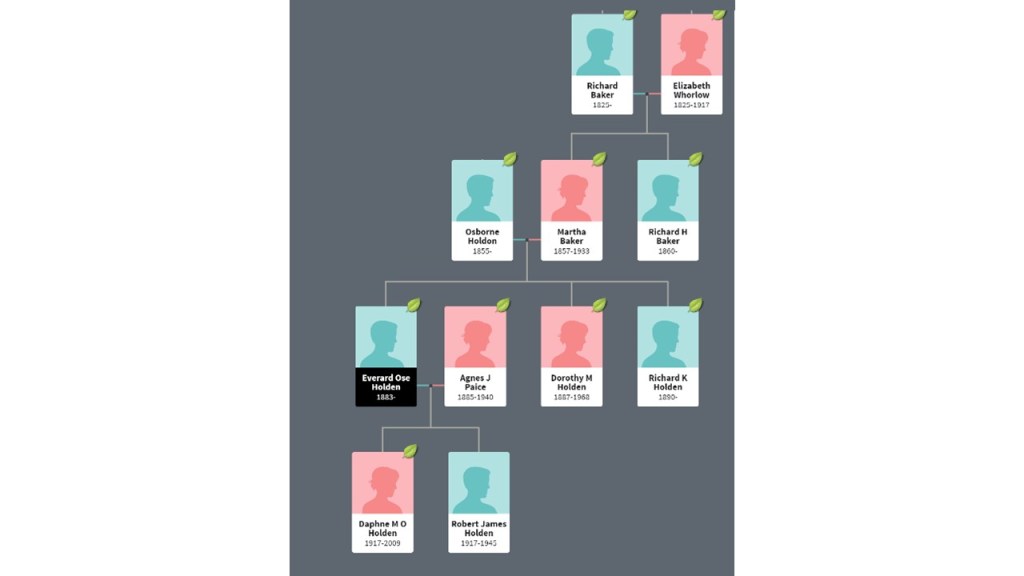
Jane Giles Whorlow (born 1828) was my third great grandmother.
Frances Whorlow (born 1830)
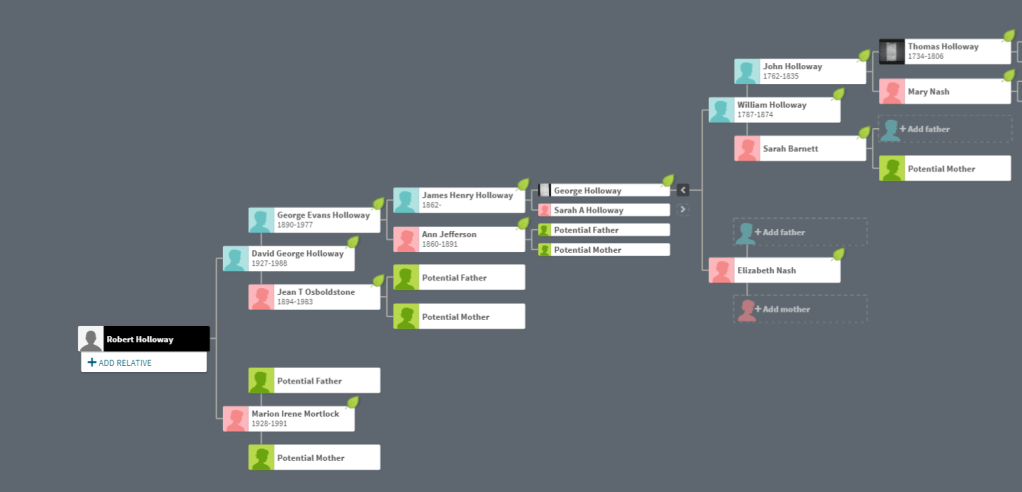
Robert Holloway – my sixth cousin, once removed
Robert’s fifth great grandfather – Thomas Holloway, is my sixth great grandfather. Robert lives in Perth, Western Australia.
His great-grandfather, James Henry Holloway was born in Kildwick, Yorkshire (not far from where I live!) and emigrated to Australia.
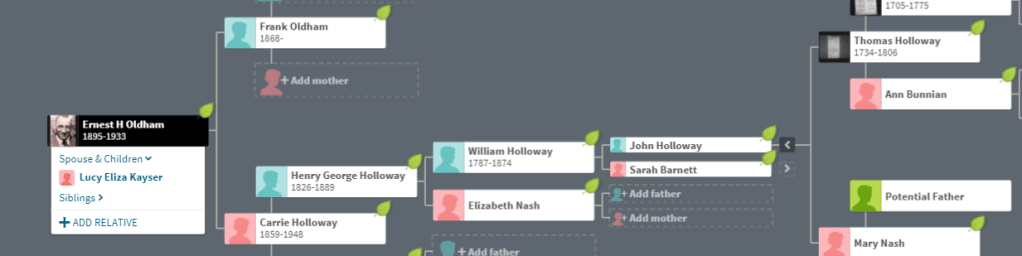
Ernest Holloway Oldham, my fourth cousin, 3 times removed
Ernest’s 3rd great-grandfather – Thomas Holloway, is my sixth great grandfather.
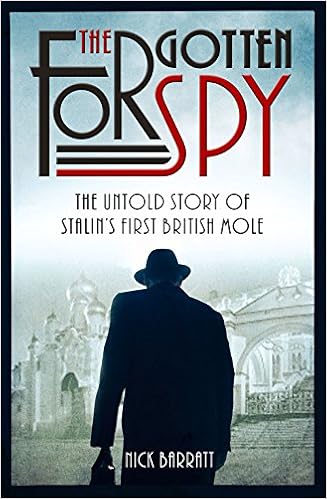
Ernest Holloway Oldham was born in Edmonton, London, on 10th September, 1894. After finishing his education in 1914 he obtained a job as a clerk in the Foreign Office. He enlisted in the Artists’ Rifles on 9th February, 1917 and was granted a temporary commission as 2nd Lieutenant in the King’s Shropshire Light Infantry on 31st October 1917. Oldham was sent to France and took part in the fighting in the last stages of the First World War.
Oldham arrived at the Western Front in November 1917 and took part in the last weeks of the Battle of Passchendale. His regiment then took part in defending the front-line during the German Spring Offensive. The war diary records that the battalion was involved in heavy fighting on 21st and 22nd March 1918: “About 3pm, unsupported by artillery who were moving back, the enemy having succeeded in outflanking the line in overwhelming numbers, it became necessary to fall back on to Vaulx. The retirement was conducted in good order. At dusk the Battalion received orders to withdraw to the GHQ line behind Vraucourt. In this the heaviest fighting the Battalion has ever known… the Battalion loss was in ‘Killed, Wounded and Missing’ 21 officers and 492 other ranks, and earned for itself the admiration of all who fought with them and added fresh laurels to the history of a gallant regiment. Only 77 other ranks survived on the evening of the 22nd of those who were in the battle.” 2nd Lieutenant Oldham was amongst the survivors.
Oldham was involved in the battalion’s assault on German positions in St Quentin’s Wood on 18th September, 1918. Dr Nick Barratt has pointed out: “The diary notes that 176 other ranks were casualties of the fighting, along with five officers. 2nd Lieutenant E H Oldham was named amongst them. We can only presume that he was taken to a mobile field clearing station or field ambulance, before additional treatment behind the lines. There is no further note in the war diary that Oldham returned to the depleted battalion for the remainder of the campaign, when they eventually broke through the Hindenburg line and fought right up to the Armistice on 11 November 1918.”
Ernest Oldham was demobilised on 11th December and returned to the Foreign Office to resume his career as a clerk. He eventually headed the department that distributed coded diplomatic telegrams. He married Lucy in 1927. According to the Daily Telegraph: “The story of Oldham and his wife Lucy is as black a secret as can be imagined. They married in 1927 when Oldham was 32 and his bride 47, although on the marriage certificate he added five years to his age and she subtracted seven from hers to disguise the gap…. He was a middle-ranking civil servant, a clerk in the top-secret cipher department of the Foreign Office, but lived in an expensive house in Kensington and kept a large car with chauffeur. Colleagues must have thought he had an independent income, as so many FO men did at the time. But that was not the case.”
It has been claimed that in 1928 he went to Paris to offer to sell information to the Soviet embassy. At first his offer was rejected by an agent of NKVD, who thought he was an agent provocateur. However, the following year he was recruited as a spy by Soviet agent, Dmitri Bystrolyotov, who posed as the suave Hungarian Count Perelly. According to John Costello and Oleg Tsarev, the authors of Deadly Illusions (1993): “Bystrolyotov… paid him £2,000 and put Oldham and his wife (who according to his report had seduced him) under Soviet control…. Because of British secrecy, the significance of the Oldham case has remained undisclosed and underestimated. The truth, as revealed by NKVD, files is that Oldham was not just a code clerk but a cypher expert who developed codes and was therefore able to provide Moscow with a great deal of information on security and secret traffic systems. The resourceful Bystrolyotov, who operated under the alias of Hans Gallieni in England, had also obtained from Oldham not only the keys to unlock a considerable volume of British cypher cables but also the names of the other paid members of the Communications Department who became targets for Soviet recruitment.”
Oldham was then passed on to Henri Pieck, a Soviet agent from the Netherlands who was a regular visitor to London. Pieck as part of a spy network that was run by Walter Krivitsky. Oldham’s codename was ARNO. His wife, Lucy Oldham, was also part of the network (codename MADAM). Oldham was paid $1,000 a month for the information he provided to the Soviet Union. It is believed that Oldham was the first Soviet spy recruited in Britain. Richard Deacon has argued: “There is evidence that Oldham did more harm to the USA and Canada than to Britain by providing the names of prospective agents in key positions in those countries. It is thought that he obtained some of these names from a mysterious female agent named Leonore. One of the Soviet contacts was a Russian oilman named Feldman who operated in Britain under the name of Voldarsky and who later started a Soviet network to spy on the USA from Canada.”
According to Gary Kern, the author of A Death in Washington: Walter G. Krivitsky and the Stalin Terror (2004), Oldham in the 1930s displayed behaviour that was “a riot of drunkenness, alcohol-related sickness, professional sloppiness, wife beating, unaccountable spending and insubordination.” This led to him being suspected of being a German spy. “He fell under suspicion of espionage when a codebook could not be found in a safe to which he had access. Then a batch of telegrams disappeared. Warned to observe standard procedures, he steadfastly refused and was forced to retire in September 1932, without pension.”
Kern claims that Oldham was surprisingly allowed “to come into the workplace, chatted with former colleagues and crept around mysteriously with nothing to do. Keys to the super-secret storeroom were left out as a test for him and were not taken, but found to contain traces of wax after one of his visits.” His controller, Walter Krivitsky, who was based in Rotterdam, described how immense was his astonishment when he heard that in spite of his dismissal Oldham was still allowed free access to the FO and to visit his friends.”
Ernest Holloway Oldham was found dead in in Kensington on 29th September, 1933. The following day The Times reported: “Kensington police are trying to trace the identity of a man aged about thirty-five, who was found dead in a gas-filled kitchen at 31 Pembroke Gardens, Kensington… the shirt bore the initials EHO.” According to Richard Deacon: “After that there was absolute silence in the press, both national and local – no mention of an inquest, no obituary, no indication of the man’s identity.” His death certificate showed that he died from “coal gas poisoning” and a verdict of suicide “while of unsound mind” was recorded.
Dmitri Bystrolyotov later admitted that the NKVD was worried that Oldham would be interrogated by MI5 and that he would reveal details of the London spy network and confessed that “our wonderful source (Oldham)… was killed by us.” Christopher Andrew, the author of The Defence of the Realm: The Authorized History of MI5 (2009) takes a different view and claims that the NKVD believed he was “assassinated” by MI5.
Walter Krivitsky defected in 1939 and informed MI5 of the Soviet spy-network that included Oldham, John Herbert King and Henri Pieck. This information led to the arrest and imprisonment of King. Only after the war, in October 1945, did MI5 arrange to bring Pieck over to London with the object of meeting Lucy Oldham. The MI5 file report shows that Lucy Oldham threw herself into the Thames at Richmond in 1950. According to Gary Kern: “The timing of her demise, apparently fortuitous for the NKVD, raised suspicions that she had been silenced”.
 Andrew Hollaway Family History